Arnold Press: Muscles Worked, Benefits & Proper Form
Table of Contents
ToggleHave you ever tried the Arnold Press and wondered what makes it different from a regular shoulder press?
I’ve asked myself the same question, especially as I became more intentional about strength training after 30. At first glance, it looks like a simple shoulder exercise, but the rotation added to the press makes the movement different from a traditional overhead press.
So, what muscles does the Arnold Press actually work, how should you perform it, and is it better than a regular shoulder press?
In this guide, I’ll break down the Arnold Press, including the muscles targeted, proper form, benefits, variations, common mistakes, and how it compares with other shoulder presses.
What Is the Arnold Press?
The Arnold Press is a dumbbell shoulder exercise that combines an overhead press with arm rotation.
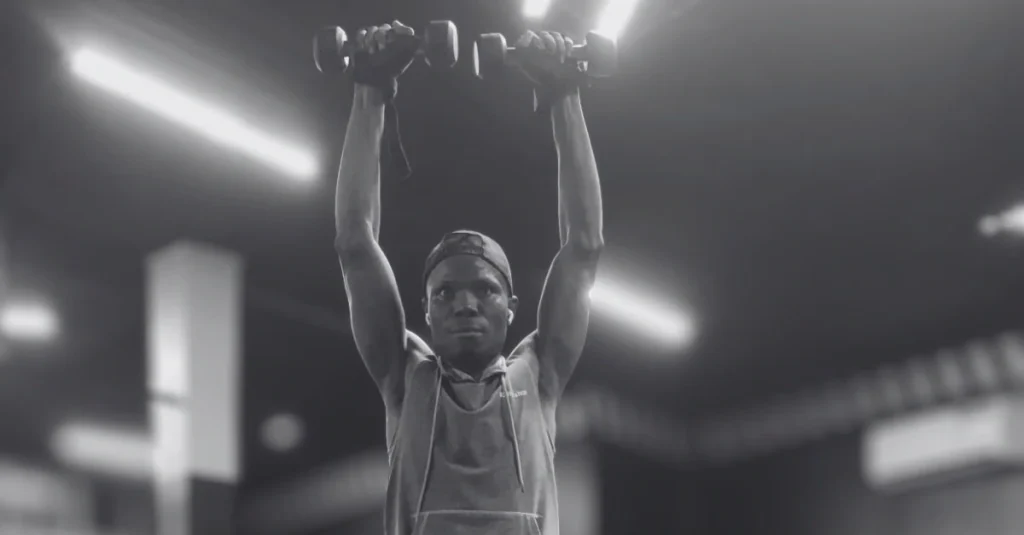
Unlike a traditional dumbbell shoulder press, where you generally start with your palms facing forward and press the weights upward, the Arnold Press begins with your palms facing toward you. As you press the dumbbells overhead, you rotate your hands outward until your palms face forward at the top of the movement.
The exercise is named after Arnold Schwarzenegger, and its defining feature is the rotation of the arms as you press the dumbbells overhead, setting it apart from a traditional shoulder press.
You can perform the Arnold Press seated or standing, although the seated version offers better stability, making it easier to focus on the movement itself.
The exercise may look complicated at first, but the basic idea is straightforward:
Start with your palms facing you → rotate as you press → finish with your palms facing forward → reverse the movement under control.
That combination of rotation and pressing makes the Arnold Press a useful variation when training your shoulders through a different movement pattern.
Why Is the Arnold Press Different From a Regular Shoulder Press?
The biggest difference is the rotation.
A traditional shoulder press mainly involves pressing the dumbbells upward. With the Arnold Press, your hands rotate as you move through the repetition, adding another component to the exercise and requiring you to control the dumbbells through a longer movement pattern.
That doesn’t automatically make the Arnold Press better than a regular shoulder press. Instead, it gives you another way to train your shoulders and can add variety to your strength-training routine.
In the next section, we’ll look at exactly which muscles the Arnold Press works and which ones do most of the work.
What Muscles Does the Arnold Press Work?
The Arnold press primarily works the deltoids, the three-headed muscle group that makes up the rounded portion of your shoulders.
Your triceps also assist during the pressing portion, while other muscles help stabilize your body and shoulder joints throughout the movement.
Below are the muscles worked during an Arnold Press Exercise.
1. Anterior Deltoid
The anterior deltoid, or front delt, is one of the main muscles involved in the Arnold press.
It contributes strongly as you press the dumbbells upward, particularly from the starting position where your palms face you. This makes the front delts an important part of the movement.
2. Lateral Deltoid
The lateral deltoid, or side delt, also contributes as you rotate and press the dumbbells overhead.
Because the movement combines rotation with pressing, the side delts are involved alongside the front delts. This is one reason the Arnold press is commonly used as a shoulder-development exercise.
3. Posterior Deltoid
The posterior deltoid, or rear delt, can contribute to the movement, particularly during the rotation and stabilization involved in the exercise.
However, I wouldn’t describe the Arnold press as a dedicated rear-delt exercise. If your goal is to develop the rear delts, you’ll generally want exercises that target them more directly.
4. Triceps
Your triceps assist during the pressing portion of the Arnold press.
As you extend your elbows to move the dumbbells overhead, the triceps help complete the press. They’re not the primary target, but they’re an important supporting muscle in the movement.
5. Core and Stabilizing Muscles
Your core and other stabilizing muscles also have a supporting role, particularly when performing the Arnold press while standing.
They help keep your torso stable as you rotate and press the dumbbells overhead. The trapezius and other muscles around the shoulder blade also contribute to stability during the movement.
So, What Does the Arnold Press Work Most?
The deltoids are the main muscles worked, with the anterior and lateral deltoids playing major roles in the pressing movement. The triceps assist with the press, while the rear delts and stabilizing muscles contribute to the movement to varying degrees.
One important point: the Arnold press shouldn’t be treated as an exercise that completely replaces other shoulder movements. It can be a useful addition to your routine, but different exercises can emphasize different areas of the shoulders.
If you’re interested in training the shoulders more comprehensively, you can also check out my full shoulder workout for a routine that targets the shoulders.
How to Do the Arnold Press With Proper Form
The Arnold press involves more movement than a standard shoulder press because you’re rotating your arms while pressing the dumbbells overhead. That makes control and positioning especially important.
Step 1: Start in the Correct Position
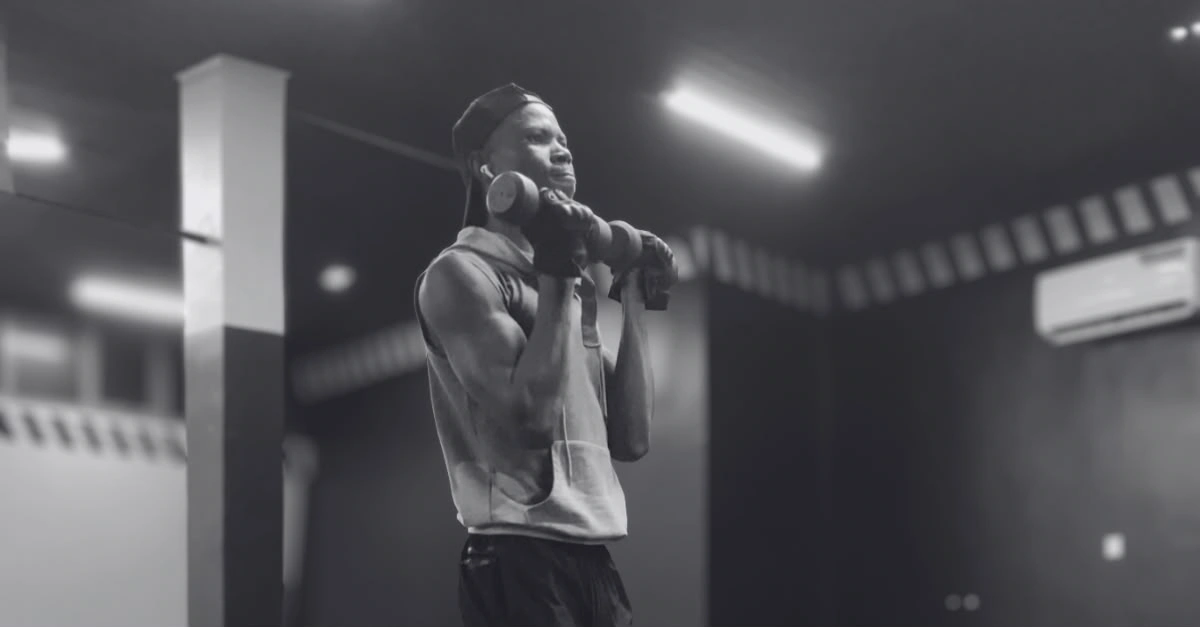
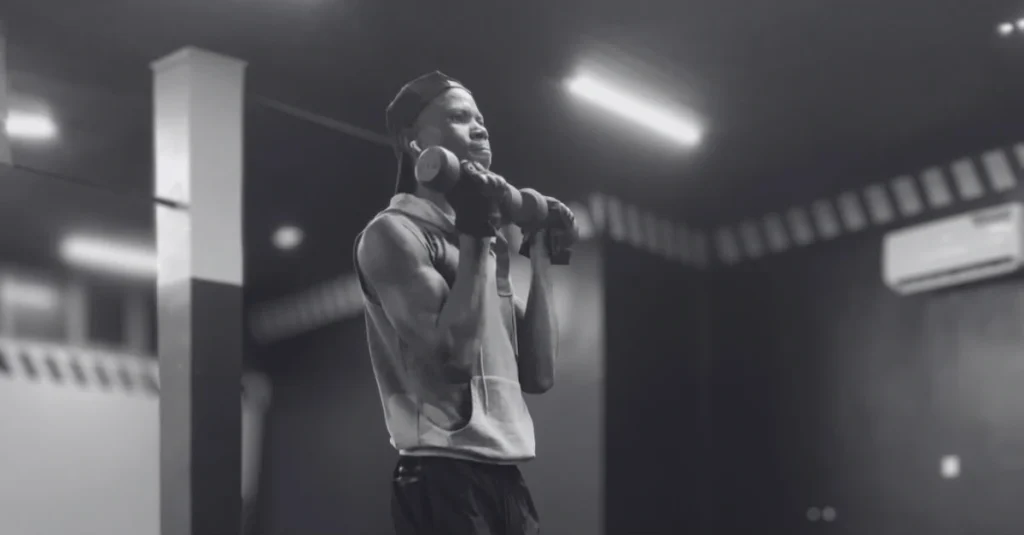
Sit on a bench with back support or stand with your feet about shoulder-width apart. Hold a dumbbell in each hand at shoulder height, with your palms facing toward you and your elbows bent.
Keep your chest up, brace your core, and avoid leaning backward as you prepare to press.
Step 2: Rotate and Press
Begin pressing the dumbbells upward while gradually rotating your hands outward.
As the dumbbells move overhead, your palms should turn from facing you toward facing forward. Try to make the rotation and pressing action one smooth movement rather than rotating first and then pressing.
Step 3: Reach the Top Position
Continue pressing until the dumbbells are overhead and your arms are extended.
Keep your core engaged and avoid using your lower back to help move the weights. You should remain in control rather than forcing the dumbbells overhead with momentum.
Step 4: Lower the Dumbbells Slowly
Reverse the movement by lowering the dumbbells while gradually rotating your palms back toward you.
Control the descent instead of allowing the weights to drop quickly. The starting position should have your palms facing your body again.
Step 5: Repeat With Control
Once you’ve returned to the starting position, repeat the movement for your desired number of repetitions.
The Arnold press is more demanding than simply pressing the dumbbells straight overhead, so start with a weight you can control throughout the entire rotation.
Arnold Press Form Tips
Keep these points in mind as you perform the exercise:
- Use a manageable weight. The rotation makes control important, so don’t sacrifice technique to lift heavier dumbbells.
- Keep your core engaged. This helps prevent excessive movement through your lower back.
- Move smoothly. The rotation and press should work together rather than feeling like two completely separate movements.
- Control the lowering phase. Don’t let gravity take over once the dumbbells are overhead.
- Don’t force the rotation. Your range of motion should feel comfortable rather than causing pain or discomfort.
A medically reviewed guide from Healthline similarly emphasizes starting with a stable posture, engaging the core, rotating the wrists gradually during the press, and reversing the movement under control.
The goal isn’t to make the Arnold press look complicated. It’s to make the entire movement smooth and controlled.
Arnold Press Benefits
The Arnold press offers more than just another way to press dumbbells overhead.
Its combination of pressing and rotation gives the shoulders a different movement pattern and can make the exercise more demanding than a traditional shoulder press.
1. Trains the Shoulders Through a Larger Movement
One of the main features of the Arnold press is the rotation that occurs as you press the dumbbells overhead.
Compared with a traditional shoulder press, the movement takes your arms through a longer path, which can increase the range of motion and require more control throughout the repetition.
2. Works Multiple Shoulder Muscles
The Arnold press primarily targets the deltoids while also working the triceps and muscles that stabilize the shoulders and torso.
This makes it a useful option when you want a pressing exercise that targets multiple muscles around the shoulders and upper body.
3. Challenges Shoulder Control
Because you’re rotating the dumbbells while pressing, you have to control the weights through more than a simple up-and-down movement.
That can make the exercise useful for developing shoulder control and stability, provided you use a weight that allows you to maintain good technique.
4. Adds Variety to Your Shoulder Training
You don’t have to choose the Arnold press over every other shoulder exercise. It can simply give your routine another pressing variation.
If you’ve been doing the same standard shoulder press for a while, adding the Arnold press can change the movement pattern while still keeping the focus on your shoulders.
Is the Arnold Press Better for Your Shoulders?
Not necessarily.
The Arnold press differs from a standard shoulder press, particularly the added rotation and larger movement pattern. But “better” depends on what you’re trying to achieve.
If you want a straightforward movement for pressing strength, a traditional shoulder press may be simpler. If you want to add rotation and a different challenge to your shoulder training, the Arnold press can be a useful option.
Seated vs. Standing Arnold Press
The Arnold press can be performed seated or standing, and neither version is automatically better. The better choice depends on how much stability you want and how well you can maintain control of the movement.
Seated Arnold Press
The seated version gives you a more stable base, especially when you use a bench with back support. This can make it easier to focus on the shoulder movement and maintain your position throughout the exercise.
It’s also a good option if you’re learning the Arnold press because it helps you focus on your rotation and pressing motion without worrying about balance.
Standing Arnold Press
The standing version removes the bench support, so your core has to work harder to stabilize your torso as you press.
It can make the exercise feel more demanding overall, but it also gives you more opportunity to use momentum or lean backward if the weight is too heavy.
Which One Should You Choose?
If you’re learning the movement or want to keep the exercise more controlled, the seated Arnold press is a good starting point.
If you’re already comfortable with the movement and want the additional challenge of stabilizing your body while standing, the standing version can be useful.
The important thing is not to choose the variation because you can lift more weight. Consistent form and good control matter more than loading the dumbbells as heavily as possible.
Arnold Press vs. Shoulder Press
The Arnold press and traditional shoulder press are both effective exercises for training the shoulders, but they use slightly different movement patterns.
The main difference is the rotation. With a traditional dumbbell shoulder press, your palms generally face forward as you press the weights overhead. With the Arnold press, you begin with your palms facing toward you and rotate them outward as you press.
Arnold Press
The Arnold press combines a shoulder press with an outward rotation of the arms. This gives the exercise a longer and more complex movement pattern and requires you to control the dumbbells throughout the rotation.
Traditional Shoulder Press
A traditional shoulder press uses a more straightforward pressing motion. You generally begin with your palms facing forward and press the dumbbells directly overhead.
Because the movement is simpler, it can be easier to focus on building pressing strength and progressively increasing the weight.
Which One Is Better?
Neither exercise is automatically better.
The Arnold press can be useful if you want to add rotation and variety to your shoulder training; the traditional shoulder press may be preferable when your goal is to focus on overhead pressing and strength.
So, instead of choosing one because it is supposedly superior, consider what you want from your workout. Both exercises can be useful, and you can include either one depending on your training goals and preferences.
Arnold Press vs. Overhead Press
The Arnold press and overhead press are closely related, but they aren’t performed in the same way. The biggest difference is that the Arnold press adds rotation to the pressing movement, while a traditional overhead press uses a more direct path.
With the Arnold press, you begin with your palms facing toward you and rotate them outward as you press the dumbbells overhead. With a traditional overhead press, your hands generally remain forward-facing as you press.
Which One Should You Choose?
If your main goal is straightforward overhead pressing and building pressing strength, the traditional overhead press may be the simpler option.
If you want to add rotation and a different movement pattern to your shoulder training, the Arnold press can be a useful variation.
That doesn’t mean one exercise is automatically better than the other. Both can train the shoulders, and your choice can come down to your goals, experience, and which movement you can perform comfortably with good form.
For most people, there’s no need to replace one with the other. The Arnold press can be another option in your shoulder routine.
Is the Arnold Press Pointless?
With so many shoulder exercises available, you might wonder whether the Arnold press is actually worth including in your routine.
No, the Arnold press isn’t pointless. It can be a useful shoulder exercise, particularly if you want to add a rotational component to your pressing work. However, it isn’t automatically better than a traditional shoulder press.
The main reason to use it is that it gives you a different movement pattern. Instead of pressing the dumbbells overhead, you rotate your arms as you press, which requires more coordination and control.
That said, you don’t need to force the Arnold press into your routine if a traditional shoulder press works better for you. If you can perform a standard press comfortably and progressively train with it, there’s nothing wrong with making it your primary pressing exercise.
The Arnold press is best viewed as another useful shoulder-training option, rather than an exercise that makes every other shoulder press unnecessary.
If you enjoy the movement, can perform it comfortably, and can maintain good form, there’s a good reason to keep it in your routine.
Common Arnold Press Mistakes
The Arnold press has an extra rotation compared with a traditional shoulder press, so rushing the movement or using more weight than you can control can make it difficult to maintain proper form.
1. Using Too Much Weight
One of the most common mistakes is choosing dumbbells that are too heavy.
When the weight is excessive, you may start using momentum, leaning backward, or rushing through the rotation to complete the repetition. Choose a weight that allows you to control the movement from the starting position through the press and back down.
2. Rotating Too Early
The rotation is an important part of the Arnold press, but it shouldn’t be rushed.
Starting the rotation too early can change your arm position and alter how the movement feels. Instead, press upward first and gradually rotate as the dumbbells move toward the overhead position.
3. Leaning Back
If you find yourself leaning backward to get the dumbbells overhead, the weight may be too heavy, or your core may not be sufficiently braced.
Keep your torso controlled and avoid turning the movement into a backward-leaning press.
4. Rushing the Repetition
The Arnold press isn’t a movement you need to perform quickly.
Control both directions of the exercise, including the rotation as you press and the reverse rotation as you lower the dumbbells. This helps you stay in control rather than relying on momentum.
5. Letting Your Elbows Drift Too Far Back
Your elbows should remain in a comfortable position as you transition from the starting position into the press.
Allowing them to move excessively behind your body can change the mechanics of the exercise. Focus instead on keeping the movement controlled and within a comfortable range.
6. Losing Control on the Way Down
Don’t focus only on getting the dumbbells overhead.
The lowering phase is part of the repetition too. Slowly reverse the movement while rotating your palms back toward you as the dumbbells return to the starting position.
The biggest takeaway: you don’t need heavy dumbbells to make the Arnold press effective. A controlled repetition with good positioning is more useful than forcing a heavier weight with poor form.
Frequently Asked Questions About the Arnold Press
Is the Arnold Press Good for Beginners?
A beginner can learn the Arnold Press, but its added rotation makes it more complex than a standard shoulder press. Starting with light dumbbells and practicing the movement with good control can make it easier to understand.
Can You Do the Arnold Press With One Dumbbell?
Yes. You can perform a single-arm Arnold press by holding one dumbbell and completing the movement with one side at a time. This can also challenge your core as you work to keep your torso stable.
Can You Do the Arnold Press at Home?
Yes. The exercise only requires a pair of dumbbells, and you can perform it seated or standing. If you’re training at home, choose a weight that allows you to complete the rotation and pressing motion without too much momentum.
Is the Arnold Press a Compound Exercise?
Yes. The Arnold press is generally considered a compound exercise because it involves movement at more than one joint and works multiple muscles, including the deltoids and triceps.
Final Thoughts
The Arnold press is a useful shoulder exercise that combines an overhead press with a controlled rotation. That added movement makes it different from a traditional shoulder press and gives you another option for training your deltoids, triceps, and supporting muscles.
The key is not to chase heavier dumbbells at the expense of your form. Start with a weight you can control, keep your torso stable, and perform the rotation and pressing motion smoothly.
Whether you choose the Arnold press, a traditional shoulder press, or both, the best exercise is one that fits your goals and allows you to train consistently with good technique.
Join the Conversation
Have you tried the Arnold press before? I’d love to hear about your experience.
Share your thoughts, questions, or favorite shoulder exercises in the comments below. Your experience might help someone else on their fitness journey after 30.